
What is Gen AI, really?
Generative AI creates new content by predicting patterns from large datasets, producing statistically plausible outputs rather than copying existing material.
Generative AI refers to machine-learning models trained on massive collections of text, images, video, audio, and code. Instead of following explicit rules, these models generate outputs by calculating probabilities and what comes next based on patterns learned from data.
Unlike traditional software (“if this happens, do that”), Generative AI works more like a predictive system. It doesn’t understand meaning the way humans do; it estimates likelihood. This distinction explains both its power and its limitations.

How does Generative AI actually work?
At its core, Generative AI is a prediction engine. Given an input, it estimates what should come next, then repeats that process thousands of times per second.
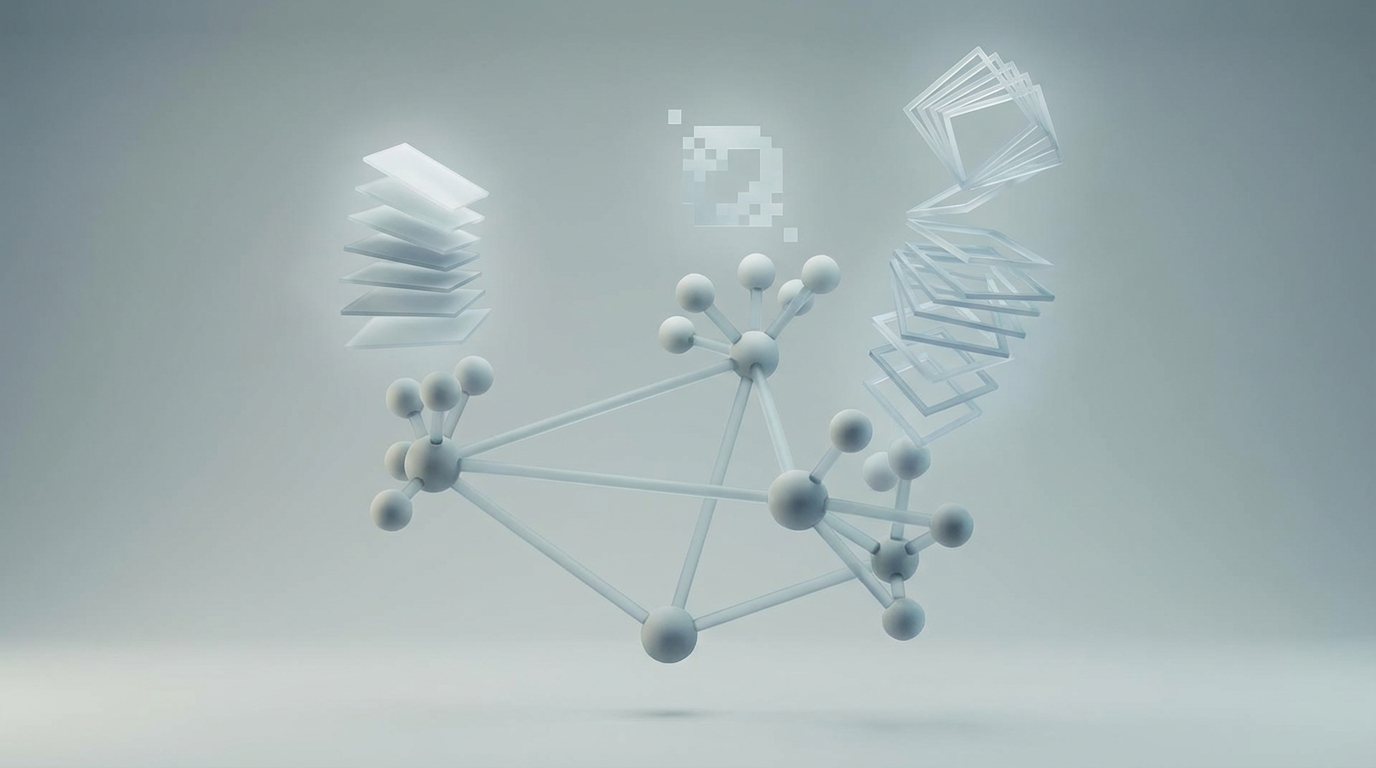
Is Generative AI just remixing existing content?
Large Language Models (LLMs) generate text by predicting word sequences.
Image models generate visuals by refining noise into recognizable forms.
Video and audio models extend these predictions across time and motion.
The model never “knows” what it’s making; it only knows what is statistically likely to follow.
Generative AI does not retrieve existing works; it learns abstract patterns and generates new outputs that are statistically plausible, not memorized.
This is one of the most common misconceptions. Generative AI does not store or recall specific images, sentences, or videos. Instead, it learns relationships: how concepts tend to appear together.
When you ask for “a sunset over a desert,” the model synthesizes its learned patterns of “sunset” and “desert.” The result can feel familiar, but it is not assembled from existing examples. It is generated from probabilities, which is why outputs can feel both recognizable and uncanny.
Generative AI is a statistical prediction system trained on human-made data that generates new content without understanding or intention.
Seen clearly, Generative AI is neither magic nor apocalypse. It is a powerful tool built on probability, trained on human output at scale.
Like cameras or editing software, its impact depends on how it is used and who is making the decisions.
What does this mean for you?
If you're evaluating Gen AI tools professionally, understand this: these models are assistants, not replacements. They're phenomenal at drafting, iterating, exploring variations, and accelerating grunt work. They're terrible at taste, intentionality, and knowing when something is done.
A Gen AI model can write ten versions of a logline in seconds. It cannot tell you which one will resonate with your audience. It can generate concept art for a scene. It cannot feel whether that art serves your story.
The creative judgment, the thing that makes your work yours, still sits with you. Gen AI compresses time and expands possibilities. It doesn't compress taste.